By orchestrating three complementary AI paradigms—reasoning engines, generative networks, and large language models—we unlock systems that are both creatively fluent and rigorously reliable.
Example Architecture:
LLM (e.g., GPT):
Handles natural language tasks like understanding queries, generating responses, summarizing data.
Reasoning Engine:
Takes over for tasks that need logic, such as math, planning steps, verifying facts.
Agentic Framework (e.g., AutoGPT, LangChain, OpenAI Function Calling): Coordinates everything. It can:
Break a goal into subtasks:
Let’s walk through an example workflow of how an Agentic AI might operate – deciding when to use Large Language Model (LLM) for text understanding/generation, Reasoning Model for logic-heavy tasks and external tools/APIs for specialized functions like search or math.
Summarize the latest research on Alzheimer’s treatments, check which ones are FDA-approved, and recommend the most promising one with scientific reasoning.
User Query
LLM is used to parse the request, recognize subtasks:
The agent uses a web search tool/API to gather recent publications or clinical trial data.
External tool used for data retrieval.
LLM is prompted to generate a summary of the top research papers.
LLM used for summarization & synthesis.
The agent uses an FDA database API, or structured data source. A Reasoning Model or logic component compares drug names against approval status.
Reasoning Model + Tool used for fact-checking.
LLM proposes a candidate.
Reasoning Model performs a logical evaluation efficacy, trial phases, side effects, approval status.
The agent ensures the recommendation is based on evidence, not just text fluency.
LLM + Reasoning Model collaborate on decision-making.
LLM crafts a clear, professional response in natural language, citing sources and reasoning steps.
LLM used for final output formatting.
HQ
13 rue Jeanne Braconnier
Immeuble Le Pasteur
92360 Meudon-La-Forêt
France
Asia
Taipei
Taiwan
Japan
Tokyo
Japan
Korea
Seoul
Korea
USA
San Diego, CA
USA
Unmatched Performance at the Edge with Edge AI.
Fully programmable
Algorithm agnostic
Host processor agnostic
RISC-V core to offload & run AI completely on-chip
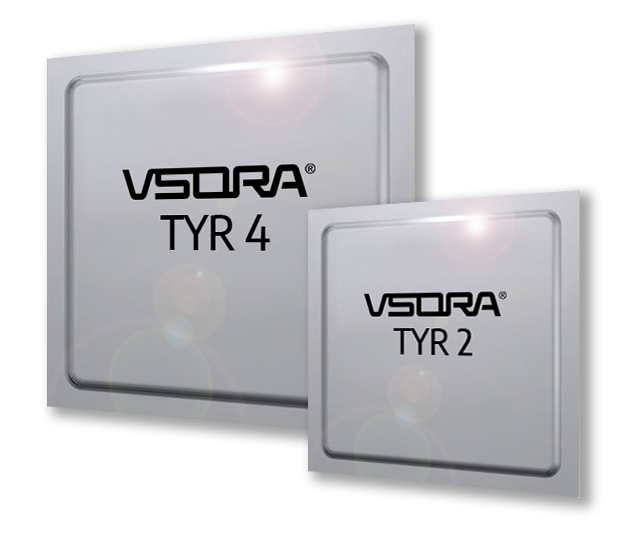
Tyr 4
fp8: 1600 Tflops
fp16: 400 Tflops
Tyr 2
fp8: 800 Tflops
fp16: 200 Tflops
Tyr 4
fp8/int8: 50 Tflops
fp16/int16: 25 Tflops
fp32/int32: 12 Tflops
Tyr 2
fp8/int8: 25 Tflops
fp16/int16: 12 Tflops
fp32/int32: 6 Tflops
Close to theory efficiency
Fully programmable
Algorithm agnostic
Host processor agnostic
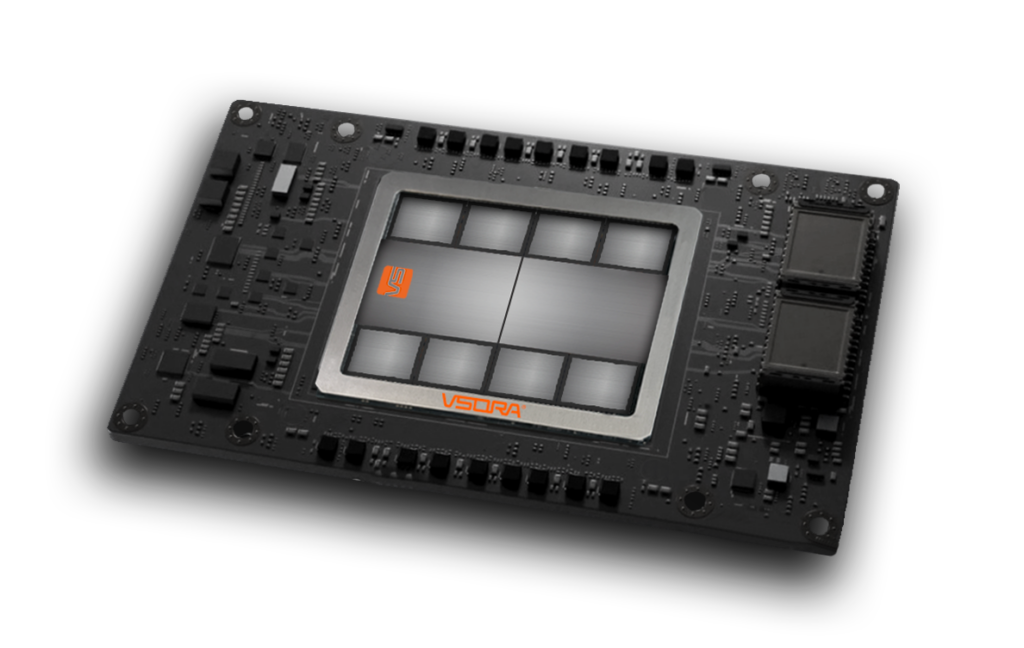
RISC-V cores to offload host
& run AI completely on-chip.
fp8: 3200 Tflops
fp16: 800 Tflops
fp8/int8: 100 Tflops
fp16/int16: 50 Tflops
fp32/int32: 25 Tflops
Close to theory efficiency